
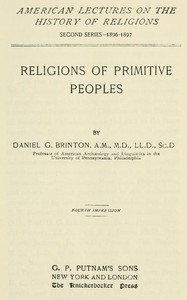
Religions of Primitive Peoples by Daniel G. Brinton
Let's be clear from the start: this isn't a novel. There's no plot twist or main character. Instead, think of it as an intellectual expedition. Daniel G. Brinton, writing in 1897, sets out to map the spiritual landscape of what were then called 'primitive' societies—primarily indigenous groups across the Americas, but also peoples from Africa and Oceania.
The Story
Brinton structures his exploration like a field guide to early human belief. He starts by asking what religion even is at its most basic level. Then, he travels through different expressions of it: animism (the idea that spirits inhabit natural objects), totemism (a spiritual connection with an animal or plant ancestor), shamanism, and early forms of myth-making. He collects stories of how the world began, examines rituals meant to please spirits or ancestors, and tries to understand the role of the priest or medicine person in these communities. The 'story' is really the story of his attempt to find order and common sense in practices that many of his contemporaries dismissed as mere nonsense.
Why You Should Read It
Reading this book is a double experience. First, you get a sweeping tour of global indigenous spiritual practices from over a century ago. Brinton's genuine curiosity and respect for the internal logic of these belief systems is compelling. He often argues against the idea that these peoples were simple or irrational. But second, and just as fascinating, you are reading a historical document itself. The language and some of the assumptions are firmly of the Victorian era. You see the birth of anthropology, warts and all. It makes you think critically about how we study other cultures, then and now. It’s less about getting the final, correct answer on 'primitive religion' and more about witnessing the early, earnest struggle to ask the question.
Final Verdict
This book is perfect for history buffs, anthropology nerds, or anyone interested in the history of religion and how we think about culture. It's not a light read, but it's a short one. Come for the survey of ancient beliefs, but stay for the chance to time-travel into the mind of a 19th-century scholar. If you approach it as both a source of information and a piece of history itself, you'll find it incredibly rewarding. Just keep a modern perspective handy to navigate the older viewpoints.
Legal analysis indicates this work is in the public domain. Thank you for supporting open literature.
Nancy Thomas
9 months agoThe author provides a very nuanced critique of current methodologies.
Margaret Smith
4 months agoThis work demonstrates a clear mastery of contemporary theories.
Jennifer Jackson
1 year agoThe clarity of the introduction set high expectations, and the structural organization allows for quick referencing of key points. I’ll definitely be revisiting some of these chapters again soon.
John White
2 years agoI started reading this with a critical mind, the quality of the diagrams and illustrations (if applicable) is top-notch. Top-tier content that deserves more recognition.




Karen Williams
1 year agoMy first impression was quite positive because the visual layout and supporting data make the reading experience very smooth. I appreciate the effort that went into this curation.