
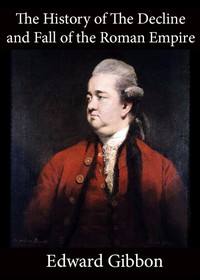
History of the Decline and Fall of the Roman Empire — Volume 3 by Edward Gibbon
Alright, let's get into it. Volume 3 of Gibbon's Decline and Fall picks up after Constantine and carries us through the dramatic collapse of the Western Roman Empire. The story is no longer centered on Rome itself, but on the new capital of Constantinople in the East and the increasingly fragile court in the West, often based in Ravenna.
The Story
Gibbon guides us through a chaotic period. We meet emperors who are sometimes children, sometimes puppets, and rarely effective. The real power often lies with generals, many of whom come from the very 'barbarian' groups pressing on the borders. The narrative follows the great migrations and invasions—the Goths under Alaric who famously sack Rome in 410, the Vandals who carve out a kingdom in North Africa and sack Rome again in 455, and the terrifying but short-lived empire of Attila the Hun. The key thread is the Eastern Empire's survival and prosperity contrasted with the West's disintegration. The final act is almost quiet: in 476, a Germanic general named Odoacer simply deposes the last Western emperor, Romulus Augustulus, and sends the imperial regalia to Constantinople. The West doesn't 'fall' with a huge battle; it just stops.
Why You Should Read It
This volume is Gibbon at his most compelling because the tragedy is fully realized. His prose, while formal, has a gripping, novelistic quality when describing the siege of Rome or the court intrigues. What stuck with me was his analysis of why the empire failed to save itself. He points to internal decay—a loss of civic virtue, political corruption, economic strain—as much as to external threats. It’s a humbling reminder that the greatest dangers to a society can come from within. Reading about the Goths being hired to defend the empire, only to later turn against it, feels uncomfortably relevant.
Final Verdict
This is for the reader who wants to understand how civilizations actually end. It's perfect for history lovers who enjoy deep dives into cause and effect, and for anyone fascinated by political drama on a grand scale. It's not a light read—Gibbon's sentences are long and his references are vast—but the payoff is immense. You finish this volume not just with knowledge of events, but with a feeling for the profound shift that occurred when the ancient world finally fractured. If you've ever wondered about the real story behind 'the Fall of Rome,' this is where you find it, in all its complicated, messy, and fascinating detail.
This content is free to share and distribute. Feel free to use it for personal or commercial purposes.
Robert Thomas
1 year agoHaving followed this topic for years, I can say that the evidence-based approach makes it a very credible source of information. Simple, effective, and authoritative – what else could you ask for?
Mary Moore
4 months agoWhile browsing through various academic sources, the data points used to support the main thesis are quite robust. The price-to-value ratio here is simply unbeatable.
Paul Hernandez
2 years agoAs a long-time follower of this subject matter, the practical checklists included are a great touch for real-world use. A trustworthy resource that I'll keep in my digital library.
Richard Lopez
1 year agoThis was exactly the kind of deep dive I was searching for, the way it handles controversial points with balance is quite professional. A mandatory read for anyone in this industry.








Donald Anderson
5 months agoVery satisfied with the depth of this material.