
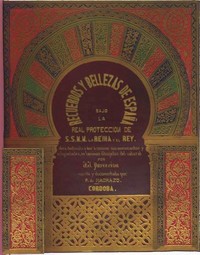
Córdoba by Pedro D. Madrazo
Pedro D. Madrazo's Córdoba isn't a novel, but it reads with the momentum of one. Written in the 1800s, it serves as a deep and loving portrait of one of Spain's most storied cities. Madrazo was an art historian and scholar, and he pours that expertise onto the page, but he does it with the eye of an artist and the heart of a local.
The Story
There's no traditional plot with characters. Instead, the city itself is the main character. Madrazo traces its life story, from its Roman roots as a provincial capital, through its dazzling golden age as the heart of the Islamic Caliphate of Córdoba—when it was one of the largest and most advanced cities in the world—and into its Christian reconquest and beyond. He guides us through its architecture, focusing intensely on the masterpiece that is the Great Mosque-Cathedral (the Mezquita), explaining how each layer of construction tells a story of faith, power, and cultural exchange. He paints pictures of forgotten palaces, bustling old markets, and quiet patios, always linking the physical city to the people and events that shaped it.
Why You Should Read It
This book changed how I see travel writing and history. It’s old, sure, but that’s its superpower. Reading Madrazo is like seeing Córdoba through the eyes of someone from the 1850s. His perspective is pre-mass-tourism, filled with a sense of discovery and a scholar's patience. You get his unfiltered awe at the Islamic architecture, which he describes with incredible detail and respect. What really stuck with me was his theme of layered identity. He shows how Córdoba isn't just a Spanish city or a Moorish city; it's a palimpsest, where each era wrote over the last but never fully erased it. That tension—between preservation and transformation—feels incredibly modern.
Final Verdict
This is the perfect book for a specific kind of reader. It's for the history buff who wants to go deeper than a Wikipedia page, for the traveler planning a trip to Andalusia who wants to truly understand what they're looking at, and for anyone who loves the idea that places have long, complicated, and beautiful memories. It's not a quick, breezy read; it asks for your attention. But if you give it, you'll feel like you've not just learned about Córdoba, but have actually lived in its past for a little while. A truly transporting experience.
This publication is available for unrestricted use. You do not need permission to reproduce this work.
Richard Martin
1 month agoI stumbled upon this title during my weekend research and the case studies and practical examples provided add immense value. It’s hard to find this much value in a single source these days.
William Gonzalez
2 months agoExceptional clarity on a very complex subject.
Barbara Martin
1 year agoUnlike many other resources I've purchased before, the narrative arc keeps the reader engaged while delivering factual content. The price-to-value ratio here is simply unbeatable.
Robert Martinez
1 year agoI appreciate the objective tone and the evidence-based approach.
Joseph Smith
2 months agoUnlike many other resources I've purchased before, the author clearly has a deep mastery of the subject matter. It’s a comprehensive resource that doesn't feel bloated.