
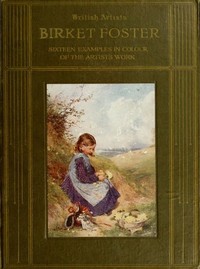
Birket Foster, R.W.S. by H. M. Cundall
Let's be honest, the title Birket Foster, R.W.S. sounds like a dusty old academic text. But H.M. Cundall's book is something much warmer and more personal. It's a portrait of the artist written by a friend and fellow art historian, which gives it a unique, insider feel.
The Story
This isn't a novel with a plot, but the story it tells is compelling. It follows Birket Foster's life from his start as a precocious kid who'd rather draw than do anything else, to his apprenticeship engraving metal, and finally to his breakthrough as a watercolorist and illustrator. Cundall shows us how Foster's gentle, detailed scenes of rural life—farmers, village greens, happy families—caught the Victorian imagination perfectly. His work was everywhere: in famous poetry books, as standalone prints people framed for their parlors, even on popular ceramics. The book charts this rise to fame, but also paints a picture of the man himself: kind, dedicated to his craft, and deeply connected to the Surrey countryside he loved.
Why You Should Read It
You should read it because it connects the dots between art and everyday life in a way that's really accessible. Cundall doesn't just list Foster's achievements; he explains why these images mattered so much. In a time of rapid industrialization and unsettling change, Foster's paintings offered comfort and a vision of a stable, peaceful England. Reading this, you start to see his art as a cultural safety blanket. I also loved the little details Cundall includes from knowing Foster personally—his working habits, his love of nature walks, his modesty. It turns a famous illustrator into a real, relatable person.
Final Verdict
This book is perfect for history buffs who enjoy social history through a personal lens, for art lovers curious about the 'Golden Age' of British illustration, and for anyone who finds the Victorian era fascinating. It's not a heavy critique; it's an appreciative and knowledgeable guided tour of one man's life and work, and through him, a whole slice of 19th-century Britain. If you've ever looked at an old painting and wondered about the hands that made it, this is your book.
This work has been identified as being free of known copyright restrictions. Enjoy reading and sharing without restrictions.
Nancy Harris
11 months agoI've been looking for a reliable source on this topic, and the evidence-based approach makes it a very credible source of information. It cleared up a lot of the confusion I had previously.
David Wilson
6 months agoI've been looking for a reliable source on this topic, and the case studies and practical examples provided add immense value. I'm glad I chose this over the other alternatives.
Patricia Johnson
2 years agoInitially, I was looking for a specific answer, but the nuanced approach to the central theme was better than I expected. Highly recommended for those seeking credible information.
Karen Martin
1 year agoAfter a thorough walkthrough of the table of contents, the wealth of information provided exceeds the average market standard. This adds significant depth to my understanding of the field.



Elizabeth Taylor
9 months agoThe citations provided are a goldmine for further academic study.