
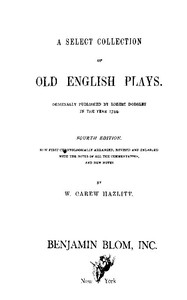
A Select Collection of Old English Plays, Volume 10 by William Carew Hazlitt
Let's be clear from the start: this isn't a novel. A Select Collection of Old English Plays, Volume 10 is exactly what it says on the tin—a curated anthology of plays from the 16th and 17th centuries. Edited by Victorian scholar William Carew Hazlitt, this volume gathers works that had largely faded from public memory. We're talking about the rough-and-tumble world of early English theater, where moral allegories bump up against raucous city comedies and historical dramas.
The Story
There isn't one story, but many. You might start with a play like "The Pinner of Wakefield," a folk-hero tale about George-a-Greene, where loyalty and cleverness win the day. Then you could jump to a biting satire like "The City Madam," which pokes fun at social climbers and greedy merchants with a humor that feels surprisingly modern. Another page might bring you a classical tragedy or a masque full of mythological figures. The plots are often simple—mistaken identities, lessons about pride, battles of wits—but they're the building blocks of the stage. They show us the raw material that later, more famous playwrights would refine.
Why You Should Read It
I loved this book because it feels like discovery. This isn't the polished, perfected drama we study in school. This is theater in its workshop phase. The characters are broad, the language can be clunky, and the messages are sometimes hammered home with little subtlety. But that's what makes it so compelling. You see the sweat and the sawdust. You get a real sense of what entertained ordinary people (and sometimes annoyed the authorities) hundreds of years ago. Reading these plays, I kept thinking, "So this is what they found funny. This is what worried them." It's a direct line to the past, unfiltered by centuries of reputation.
Final Verdict
This book is a niche treasure. It's perfect for history buffs, theater lovers, and anyone with a serious curiosity about where stories come from. It's not a light read—the old language takes some getting used to, and the lack of a single narrative thread means you have to be in the mood to explore. But if you're willing to put in the effort, it's incredibly rewarding. Think of it less as a book to read from cover to cover, and more like a museum you can wander through, stopping at whatever exhibit catches your eye. You won't find flawless masterpieces here, but you will find the fascinating, lively, and very human origins of English drama.
There are no legal restrictions on this material. Knowledge should be free and accessible.
Emily Wilson
2 years agoSolid information without the usual fluff.
Patricia Thomas
1 year agoSolid story.
Kevin Anderson
11 months agoA must-have for anyone studying this subject.
John Rodriguez
3 months agoWow.


Thomas Davis
1 year agoI appreciate how this edition approaches the core problem, the author clearly has a deep mastery of the subject matter. An excellent example of how quality digital books should be formatted.